There was still a basic code test when I first got my ticket in the early 2000s, so I crash-coursed myself past 5wpm, got my license, and got on the air. After the magic of the first couple of QSOs, I hated it. Trying to rag chew at tectonic speeds with the world‘s cheapest straight key that had sandpaper for bearings just didn’t draw me in. So, I leaned into digital modes (anyone remember PSK31 as fondly as I do?) and moved on.
Now that I always operate portable-style — even if it’s just “back yard portable” — SOTA and POTA provide plenty of opportunities for quick, structured exchanges, and packing my rig around rewards weight savings, I’m re-learning Morse and getting re-oriented on CW operation. One of the ways I’d like to do that is with LICW’s classes.
But I feel rude when I practice. My wife is wonderful and supportive, but doesn’t want to hear it. Which makes sense. A noisy, literally monotone, inscrutable background noise does not make for a pleasant afternoon if you’re not the one on the radio. Listening to Youtube, or Morse Ninja, or playing with the Morse Tutor I bought from VE6LK are all headphone-friendly. With LICW, I need to play the code oscillator into a microphone, which means it’s audible around the house.
CW practice is perfectly family friendly, but it’s not always friendly to my family.
So, I turned it into a project.
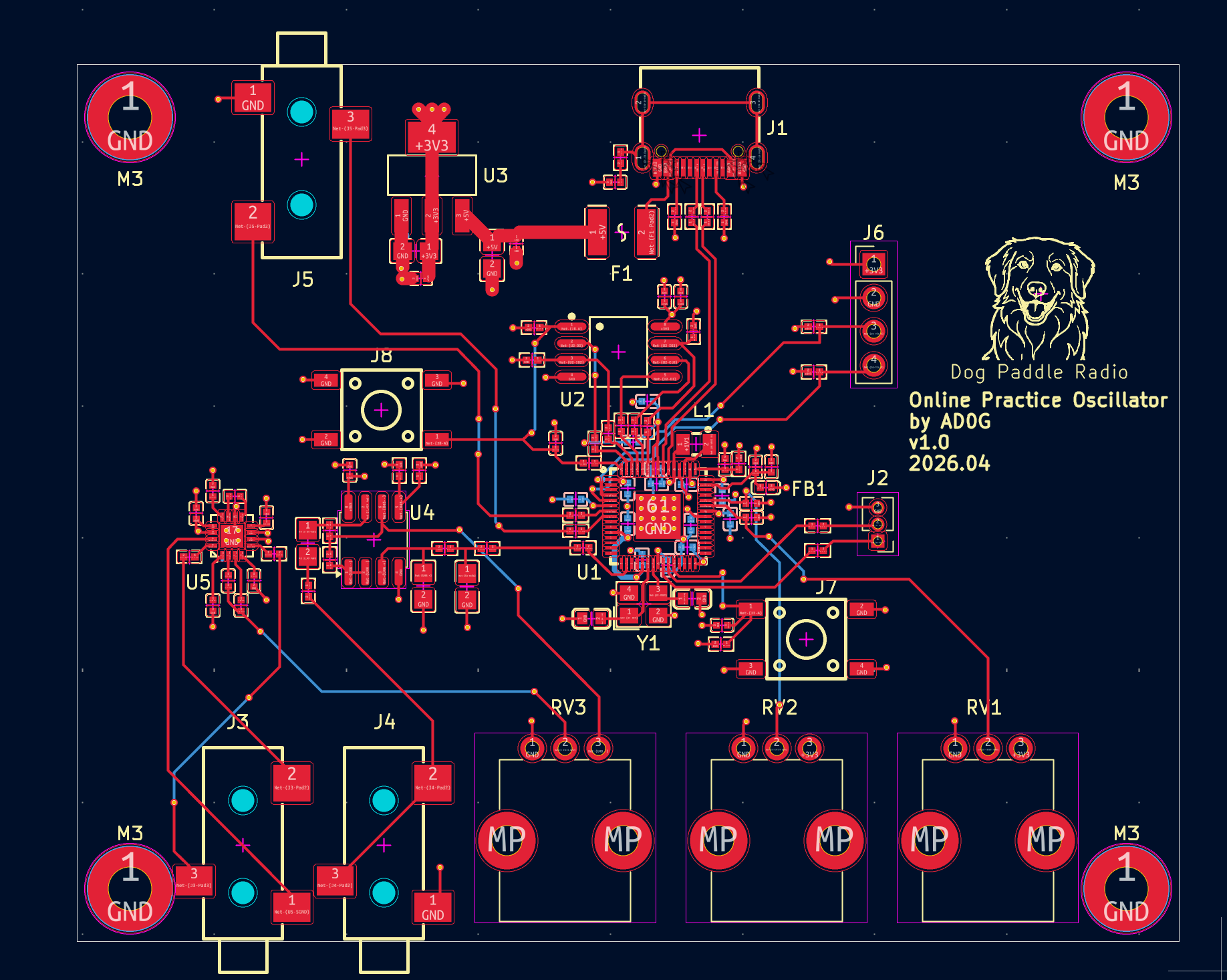
I designed a board that’s my perfect, purpose-specific CW oscillator. I can control the speed, I can control the volume, just like basically any other oscillator.
But I have a line-level out so I can plug it into my audio interface. That will let me configure a composite device on my computer so that my microphone and key are joint inputs on LICW’s zoom call. Practice online in silence. Stealth CW. Non-disruptive live practice.
Overkill? Of course. I could have put a little attenuator on the headphone line of basically any CW oscillator, and been done in 2 seconds after spending $6. But what’s the point of a hobby that doesn’t start with the question “Is there a harder way to do this?”
Really, this is training for other projects. It was a pretty significant design effort. Way more complex than any board I’d designed in the past. I learned a lot about PCB layout, about KiCAD, about JLCPCB for board production and assembly. Once it’s in my hands, I’ll learn a lot about microcontroller development.
Those are all evolutions I need for my overly aspirational long term project: The fully home brewed HF SDR I’m working on. More on that to follow.