I’m knee deep in the planning and design details of a really ambitious homebrew radio project. It’s in the exciting stage where things tip from notes and research to solder and signals. Also, if you’re laughing at the world’s smallest pun like I am, I salute you.
I want to use ST’s PD55015-E as my power amplifier, but it’s a UHF chip, and I’m building an HF radio. I haven’t been able to find any projects or precedents using this thing at HF, so I need to run some tests on it first to see if it’s viable, or if I need a new plan.
My go/no-go is around determining bias voltage, input and output impedance across HF, determining the drive level that’ll get me to 10w, what does the intermodulation distortion look like for HF, and do I have any heat dissipation concerns. Good answers let me proceed, and good data let me match the PA to the rest of the rig. It‘s probably not everything I need to know, and it’s definitely not everything I’d like to know, but it’s enough for a decision.
The test setup is simple, and honestly not worth fabricating a custom PCB. It’s only good for this test, and I doubt I’ll ever run another round of these. But almost everything I’m using is SMD, and dead bug construction was never my strength when I had leads to work with. Trying to piece this together without a board is a non starter.
So I carved one.
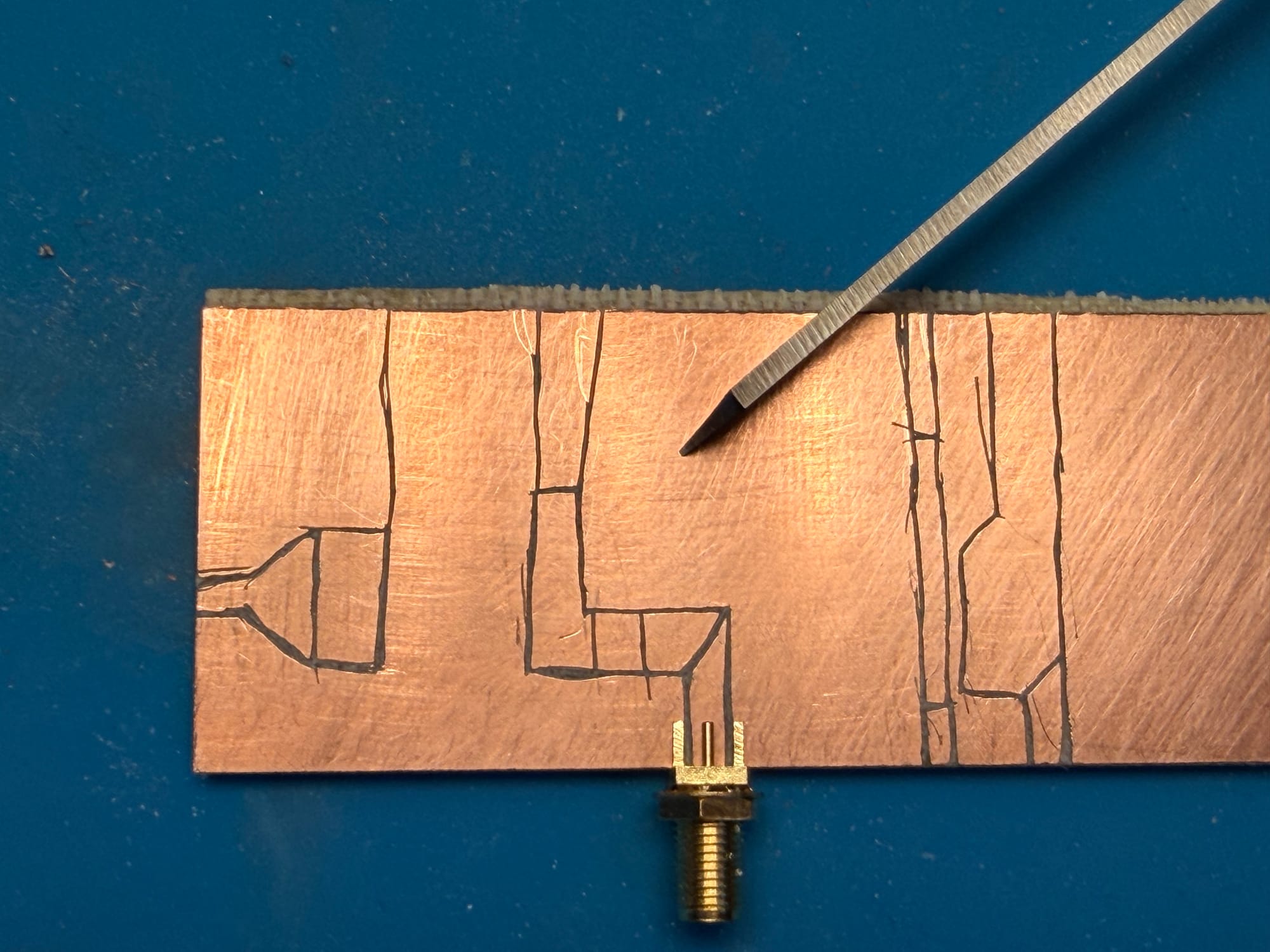
I’ll have four of those SMA connectors: 2 for the PA stage and 2 for the drive stage, which I’ll use in the final tests in this cycle. There I’m using a much more predictable GALI-84+. I don’t need to make everything difficult for myself.
I carved the board using a jeweler’s graver, shown in the photo. It’s a neat little tool, and getting clean passes through the thin copper was generally pretty easy. Not always easy, as you can see where some of the divisions went a little off the rails. But easy enough to lay things out, and multiple gentle passes to widen the dividing lines. Also, sharpen your graver often if you decide to try this.
I still need to solder everything down, which will be the first actual proof of this plan. Do things stay in place, or does solder run everywhere like the Mississippi during a spring thaw. With a little luck, a little care, and a little solder wick, I’m hopeful that I’ll be OK.